
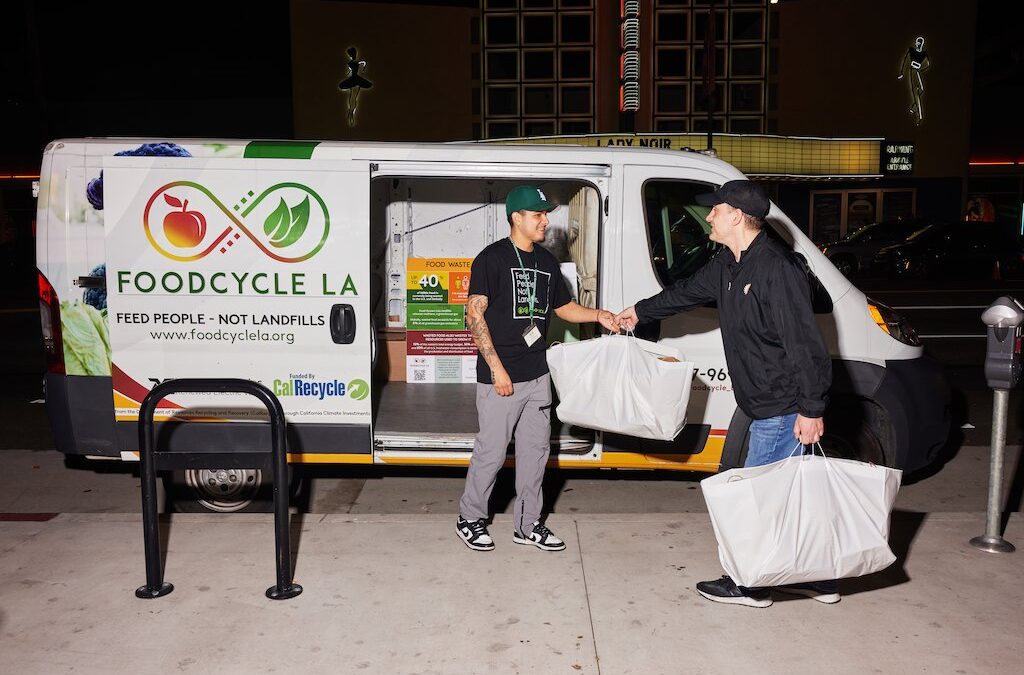
Every day across Los Angeles County, thousands of tons of perfectly edible food are discarded while families throughout our communities struggle to put healthy meals on the table. It’s a contradiction that’s difficult to ignore. We live in one of the world’s most productive food economies, yet food insecurity continues to affect nearly one in four households.
The problem isn’t a lack of food.
It’s a lack of efficient systems that connect surplus food with the organizations and people who need it most.
Fortunately, that is beginning to change.
Across Los Angeles, businesses are recognizing that surplus food isn’t waste—it’s a valuable community resource. Grocery stores, restaurants, food manufacturers, hotels, entertainment venues, and corporate campuses are increasingly incorporating food recovery into their operations, reducing waste while strengthening the communities they serve.
At the same time, California’s SB 1383 has accelerated this movement by establishing edible food recovery requirements for many larger food-generating businesses. While some organizations initially viewed the law as another regulatory obligation, many have discovered something much more meaningful: food recovery is one of the simplest and most effective ways to reduce environmental impact while making a measurable difference in people’s lives.
At FoodCycle, we’ve seen firsthand what happens when businesses, nonprofits, and local governments work together toward a shared goal.
Since 2019, FoodCycle has recovered more than 33 million pounds of surplus food—providing the equivalent of more than 27 million meals through partnerships with more than 500 businesses and a network of over 250 nonprofit organizations serving communities throughout Los Angeles County.
Those numbers represent far more than statistics.
They represent children receiving fresh produce after school. Seniors stretching limited incomes with healthy groceries. Families facing difficult financial decisions who can spend less on food and more on housing, transportation, or healthcare. They also represent millions of pounds of food that never entered a landfill, preventing the methane emissions created when food decomposes as waste.
Food recovery addresses two of our region’s most pressing challenges at the same time: hunger and climate change.
A Better Way to Think About Surplus Food
For decades, businesses viewed excess food as an unavoidable cost of doing business. Unsold inventory, catering leftovers, prepared meals, or surplus produce often ended their journey in dumpsters simply because there wasn’t an efficient alternative.
Today, technology, logistics, and stronger community partnerships have transformed that equation.
Instead of paying to dispose of wholesome food, businesses can redirect it to nonprofit organizations that distribute it to families experiencing food insecurity. What once represented a disposal expense becomes a community investment with measurable environmental and social benefits.
This shift is changing how organizations think about sustainability.
Food recovery is no longer simply a charitable activity. It has become an essential component of responsible business operations—one that supports environmental goals, strengthens relationships with local communities, engages employees, and demonstrates corporate leadership.
Businesses increasingly recognize that sustainability isn’t only about reducing packaging or lowering energy use. It’s also about making better use of the resources they already have.
Food deserves to nourish people—not landfills.
FoodCycle by the Numbers
Over the past several years, FoodCycle has built one of Southern California’s most comprehensive edible food recovery networks.
Our impact includes:
-
More than 33 million pounds of food recovered since 2019
-
Over 11 million pounds recovered in 2025 alone
-
More than 9 million meals provided in 2025
-
More than 500 business partners
-
More than 250 nonprofit organizations receiving food
-
Seven-day-a-week operations throughout Los Angeles County
Every pound of food recovered represents collaboration between businesses committed to reducing waste and nonprofit organizations dedicated to serving their communities.
That collaboration is what makes the system work.
Why Businesses Are Choosing Food Recovery
While every organization has its own reasons for donating surplus food, most discover that food recovery delivers benefits far beyond compliance with state regulations.
Reducing waste disposal costs is often one of the first advantages businesses notice. Recovering edible food instead of sending it to landfill can reduce hauling expenses while improving overall waste diversion rates.
For many companies, food recovery has also become an important part of their Environmental, Social, and Governance (ESG) initiatives and Corporate Social Responsibility (CSR) programs. Donation data provides meaningful, measurable outcomes that can be incorporated into sustainability reports while demonstrating a tangible commitment to the communities where employees and customers live.
Employee engagement is another significant benefit.
Many businesses tell us that staff members appreciate working for organizations that prioritize sustainability and community impact. Some of our corporate partners have even expanded their involvement by participating in volunteer events, allowing employees to see firsthand how rescued food reaches local families through FoodCycle’s nonprofit network.
Perhaps most importantly, businesses consistently tell us that donating surplus food simply feels like the right thing to do.
Knowing that wholesome food will nourish people rather than become waste aligns with the values of many organizations and their employees.
It’s good for the environment.
It’s good for the community.
And increasingly, it’s good business.
Why This Matters More Than Ever
Los Angeles has always been a city built on innovation and collaboration. Solving food insecurity and reducing food waste requires both.
No single organization can solve these challenges alone. Businesses, nonprofit organizations, local governments, and community leaders each play an essential role in building a stronger local food system.
Fortunately, those partnerships are already producing remarkable results.
Every grocery store that donates fresh produce.
Every restaurant that recovers prepared meals.
Every manufacturer that redirects surplus inventory.
Every corporate campus that donates food from its cafeteria.
Together, these individual decisions create a powerful network capable of transforming millions of pounds of surplus food into healthy meals for our communities.
The good news is that getting started is far easier than many businesses realize.
Making Food Recovery Simple: How Businesses Can Turn Surplus into Community Impact
One of the biggest misconceptions about food recovery is that it’s complicated.
Many businesses assume donating food will require additional staff, complicated logistics, or significant changes to their daily operations. Others worry they simply don’t generate enough surplus food to make a difference.
In reality, most organizations are already doing the hard part—they’re producing high-quality food. Food recovery simply creates a better destination for the food that isn’t sold or served.
Whether it’s fresh produce that has reached the end of its retail display, prepared meals from a corporate cafeteria, bakery items, dairy products, or food left over from a catered event, nearly every food business generates surplus that can benefit the community.
The key is having the right systems in place.
That’s where an experienced food recovery partner makes all the difference.
Food Recovery Should Fit Your Business—Not the Other Way Around
Every business operates differently.
A neighborhood grocery store has different needs than a university dining hall. A television production has a different schedule than a food manufacturer. A farmers market closes once a week, while a corporate cafeteria generates surplus every day.
Rather than expecting businesses to adapt to a standard model, FoodCycle builds recovery programs around existing operations.
Some partners schedule daily pickups.
Others donate several times each week.
Some contribute pallet-sized donations from distribution centers, while others recover prepared meals after special events.
The objective is always the same: make donating surplus food easier than throwing it away.
Our logistics team coordinates pickups, ensures food is handled safely, and delivers it quickly to nonprofit partners throughout Los Angeles County. Businesses don’t have to search for recipient organizations or coordinate multiple deliveries. FoodCycle manages those relationships, allowing donors to focus on what they do best.
By simplifying the process, we’ve helped hundreds of businesses make food recovery a routine part of their operations rather than an occasional charitable effort.
California’s SB 1383 Is Accelerating Change
California’s SB 1383 has brought new attention to edible food recovery, but its purpose extends well beyond regulatory compliance.
The legislation was designed to reduce the amount of organic waste entering landfills, where decomposing food generates methane—a greenhouse gas significantly more potent than carbon dioxide. At the same time, the law recognizes that wholesome food should be recovered whenever possible to help address food insecurity.
For many businesses, SB 1383 has created an opportunity to rethink how surplus food is managed.
Instead of viewing edible surplus as waste, organizations are increasingly recognizing it as a valuable community resource.
The law requires certain businesses to establish edible food recovery partnerships and maintain records documenting those donations, but it doesn’t prescribe a single way to accomplish those goals.
That’s why choosing the right recovery partner is so important.
FoodCycle helps businesses navigate these requirements while creating recovery programs that are practical, efficient, and sustainable over the long term.
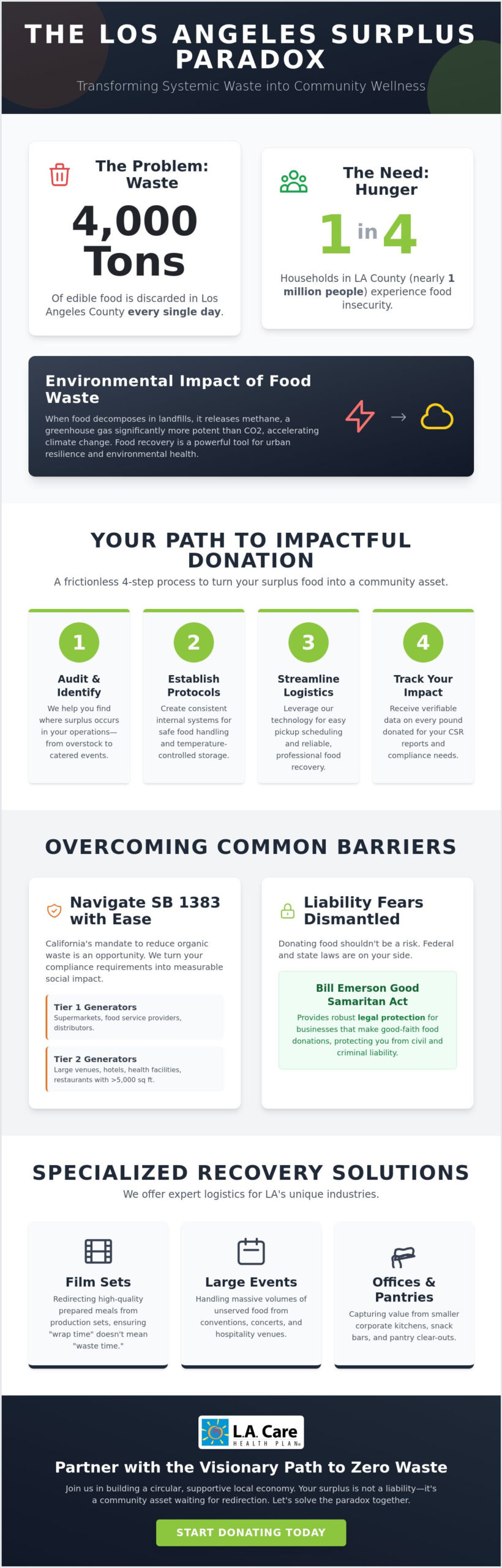
Understanding Tier 1 and Tier 2 Requirements
SB 1383 applies to businesses based on their size and role within the food system.
Tier 1 businesses include many supermarkets, grocery stores, wholesale food distributors, and food service providers.
Tier 2 expands those requirements to include many large restaurants, hotels, healthcare facilities, event venues, and other food-generating organizations.
While the specific requirements vary, the overall objective remains consistent: recover as much edible food as possible before it becomes waste.
FoodCycle supports businesses by providing:
-
Written Edible Food Recovery Agreements
-
Reliable pickup schedules
-
Documentation for inspections
-
Donation tracking and reporting
-
Ongoing support with recordkeeping requirements
-
Partnerships with qualified nonprofit organizations
Instead of navigating these requirements independently, businesses can rely on an experienced partner that understands both the regulatory expectations and the practical realities of daily operations.
Food Safety Is Always the Highest Priority
Another common concern we hear from prospective partners is food safety.
Businesses invest significant time and resources maintaining high food safety standards, and they want to be confident that donated food will be handled with the same level of care.
At FoodCycle, food safety is at the center of everything we do.
Our team works closely with donors to ensure food is properly stored before pickup, transported under appropriate temperature controls, and delivered promptly to nonprofit organizations equipped to distribute it safely.
Professional logistics matter.
Maintaining the cold chain, documenting donations, and coordinating timely deliveries all help ensure that rescued food reaches families in the same condition it left the donor.
Food recovery succeeds because it combines compassion with professionalism.
Understanding Liability Protection
Despite the strong legal protections that exist, concerns about liability continue to discourage some businesses from donating food.
Fortunately, both federal and California law were specifically designed to remove that barrier.
The Bill Emerson Good Samaritan Food Donation Act protects businesses that donate wholesome food in good faith to nonprofit organizations, shielding donors from civil and criminal liability except in cases of gross negligence or intentional misconduct.
California’s Good Samaritan Food Donation Act provides additional protections and encourages the donation of wholesome food that may no longer be suitable for retail sale but remains safe for consumption.
These laws reflect an important public policy goal: making it easier—not harder—for businesses to donate nutritious food instead of throwing it away.
When combined with established food safety practices and experienced recovery logistics, businesses can donate with confidence knowing they’re making a meaningful contribution to their communities.
A Partnership Built on Trust
Successful food recovery depends on trust.
Businesses trust that FoodCycle will handle donations professionally, maintain food safety, and provide accurate reporting.
Nonprofit partners trust that the food they receive will arrive safely and consistently.
Families trust that the food distributed through community organizations is fresh, nutritious, and handled with care.
That trust is built one pickup at a time.
For more than a decade, FoodCycle has been refining the systems, relationships, and logistics that make this possible. Today, those partnerships have grown into one of Southern California’s most effective food recovery networks—one that continues to expand as more businesses discover that recovering surplus food isn’t just good for the environment.
It’s good for business, and it’s good for the community.
Partnerships That Make a Difference
One of the greatest strengths of food recovery is that no two partnerships look exactly alike.
Every business generates surplus food differently, has unique operational needs, and serves different customers. A successful food recovery program recognizes those differences and develops solutions that fit seamlessly into each organization’s workflow.
At FoodCycle, we’ve spent years building relationships with businesses across Los Angeles County—from neighborhood markets to national retailers, restaurants, entertainment venues, food manufacturers, and corporate campuses. Today, our network includes more than 500 business partners who share a common belief: wholesome food should nourish people, not landfills.
While every partnership is unique, they all demonstrate what’s possible when businesses and nonprofits work together to strengthen their communities.
Scaling Food Recovery Through Smart Logistics: Erewhon
As Erewhon has expanded throughout Southern California, so has its commitment to reducing food waste.
Rather than coordinating pickups from every individual store, FoodCycle worked with Erewhon to create a more efficient recovery system by collecting surplus food from a central warehouse where donations from multiple stores are aggregated. This approach streamlines transportation, reduces operational costs, minimizes vehicle trips, and allows larger quantities of food to be recovered more efficiently.
The results speak for themselves.
Since the partnership began, FoodCycle has recovered 245,574.85 pounds of food from Erewhon—equivalent to approximately 204,646 meals provided to nonprofit organizations throughout Los Angeles County.
More importantly, that food has reached families, seniors, veterans, transitional housing programs, youth organizations, and community food pantries that rely on consistent access to fresh, nutritious food.
The Erewhon partnership demonstrates an important lesson: thoughtful logistics can dramatically increase the amount of food recovered while making the donation process easier for businesses.
Building Community from Day One: CAVA
Food recovery isn’t only about what happens after a business opens its doors.
It can be part of a company’s community engagement from the very beginning.
As CAVA has expanded throughout Los Angeles, FoodCycle has partnered with the company during grand opening celebrations to ensure that surplus food from opening events is recovered rather than discarded.
These events have also created opportunities to introduce guests to the broader impact of food recovery. By hosting educational tables during grand openings, FoodCycle shares how rescued food supports local nonprofit organizations, reduces methane emissions, and helps businesses become part of a more sustainable local food system.
For guests attending a restaurant opening, it’s an opportunity to see sustainability in action—not as an abstract concept, but as a practical commitment that begins on the very first day of business.
These partnerships illustrate an important point.
Food recovery isn’t simply a back-of-house operation.
It reflects a company’s values and demonstrates how businesses can contribute to stronger, healthier communities while reducing their environmental footprint.
A Longstanding Commitment to Food Recovery: Whole Foods Market
FoodCycle’s relationship with Whole Foods Market spans many years and reflects what can happen when food recovery becomes part of an organization’s culture.
Across multiple store locations, Whole Foods Market has consistently partnered with FoodCycle to ensure that wholesome surplus food reaches nonprofit organizations instead of landfills. Beyond donating food, Whole Foods team members have participated in volunteer events alongside FoodCycle staff, giving employees the opportunity to experience firsthand the impact their donations have on local communities.
These volunteer experiences often leave a lasting impression.
Employees meet nonprofit partners, help distribute rescued food, and see how a simple donation can become fresh groceries for families facing food insecurity. They witness the efficiency of the food recovery system and the collaboration required to make it successful.
Those experiences reinforce that food recovery isn’t simply a compliance requirement or sustainability initiative—it’s an investment in the neighborhoods where businesses operate.
Long-term partnerships like this are built on trust, consistency, and a shared commitment to reducing food waste while strengthening communities.
Supporting Every Type of Food Business
Food recovery isn’t limited to grocery stores.
Every day, FoodCycle works with businesses throughout the food supply chain, including:
-
Grocery stores and supermarkets
-
Restaurants and cafés
-
Food manufacturers
-
Produce distributors
-
Hotels and hospitality groups
-
Hospitals and healthcare facilities
-
Universities and schools
-
Corporate campuses
-
Film and television productions
-
Concert venues and special events
-
Farmers markets
Each sector presents different opportunities for recovery.
A grocery store may donate fresh produce, dairy products, and bakery items. A film production may have high-quality prepared meals remaining after a day’s filming. A corporate campus may recover food from employee cafeterias or catered meetings. Farmers markets often have fresh produce available at the end of the day that would otherwise go unsold.
Rather than asking businesses to fit into a standard program, FoodCycle develops recovery systems that work with existing operations, making food donation a routine part of doing business.
Join the Movement
Every day, businesses throughout Los Angeles are choosing to recover nutritious food instead of sending it to landfill.
Those choices strengthen nonprofit organizations, reduce greenhouse gas emissions, support families experiencing food insecurity, and create a more resilient local food system.
FoodCycle is proud to partner with businesses that believe surplus food should be part of the solution.
With more than 33 million pounds of food recovered, partnerships with 500 businesses, and a network of 250 nonprofit organizations, we’ve seen what is possible when communities work together.
If your organization is ready to reduce food waste, simplify SB 1383 compliance, and make a lasting investment in Los Angeles, we’d love to start the conversation.
Together, we can feed people—not landfills.