

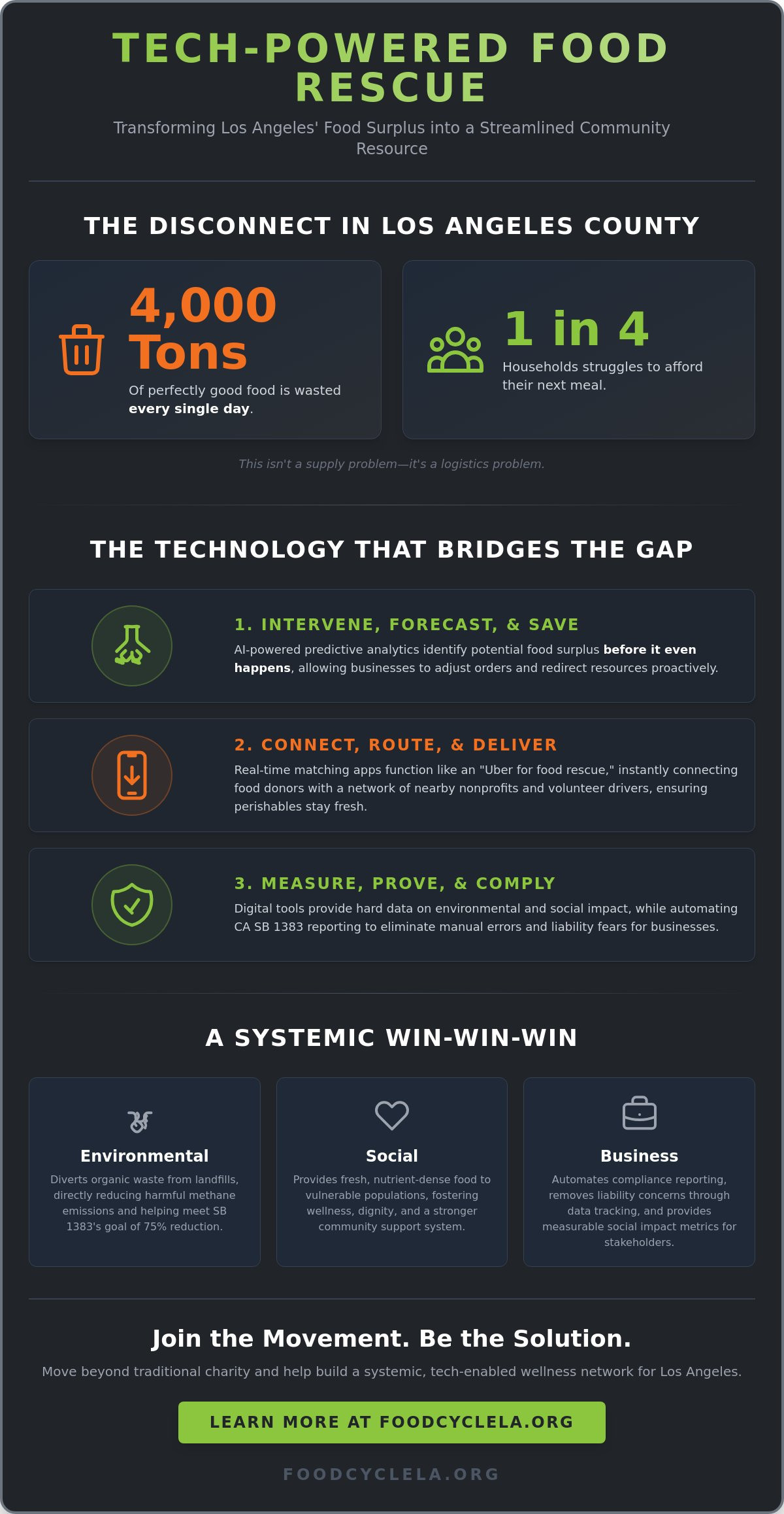
Waste is inefficiency. Hunger is oversight. Innovation is the answer. Every single day, Los Angeles County generates 4,000 tons of food waste, yet one in four local households struggles to afford their next meal. This gap isn’t a lack of resources; it’s a failure of our current systems to connect surplus with need. You likely feel the weight of this contradiction every time you see perfectly good food hit the bin because the logistics of pickup seem too complex or the fear of SB 1383 liability feels too high.
We agree that manual tracking and reporting confusion shouldn’t stand in the way of communal care. This article will show you how food recovery technology is finally solving these logistical hurdles by turning surplus into a streamlined community resource. You’ll discover how AI-driven platforms and real-time data can automate your compliance reporting, eliminate manual errors, and provide the measurable social impact data your stakeholders demand. We’re moving beyond traditional charity into a new era of systemic, tech-enabled wellness for our entire community.
Key Takeaways
- Modernize. Automate. Comply. Don’t let manual logs hold you back when food recovery technology can streamline your SB 1383 reporting and eliminate liability.
- Intervene. Forecast. Save. Learn how predictive analytics identify surplus before it happens, allowing you to redirect resources toward community wellness.
- Connect. Route. Deliver. Discover how real-time matching apps navigate the unique logistical hurdles of Los Angeles to get fresh food into our neighborhoods.
- Measure. Prove. Lead. Move beyond vague intentions by using digital tools that provide hard data on our collective environmental and social impact.
What is Food Recovery Technology and Why Does it Matter in 2026?
Waste is a choice. Hunger is a failure. Innovation is the solution. We define food recovery technology as a sophisticated ecosystem of digital tools and physical logistics designed to redirect surplus edible food from landfills to the people who need it most. It’s more than just a donation app; it’s the operational backbone of a modern, circular food system that treats surplus as a resource rather than a liability.
In 2026, the era of “waste management” has evolved into “resource redirection.” For too long, businesses relied on manual spreadsheets and chaotic phone chains to manage overages. Those archaic methods simply can’t keep up with the speed of a professional kitchen or the urgency of a hungry community. Today, nearly 40% of the U.S. food supply goes uneaten, while one in four households in Los Angeles County struggles to afford a meal. This isn’t a supply problem. It’s a logistics problem that only high-velocity innovation can solve. We’re moving beyond the moral tragedy of waste toward a data-driven reality where every calorie is accounted for and every neighbor is fed.
Breaking the Cycle of Systemic Inefficiency
Traditional food rescue models often struggle to capture small, high-frequency surplus from local cafes, restaurants, or corporate offices. Intervening tech changes this by catching food at the point of surplus before it ever becomes organic waste. By providing real-time data visibility, we’re creating an equitable system where wellness isn’t a luxury, but a shared community standard. This technology allows us to see gaps in the system before they become crises, ensuring that our collective resources are distributed with precision and care.
The Environmental and Social ROI
Measure. Act. Transform. The impact of food recovery technology is both environmental and deeply human. When we keep organic matter out of landfills, we directly reduce methane emissions, making these tools a critical part of the fight against climate change. In California, where SB 1383 mandates a 75% reduction in organic waste, these digital systems are no longer optional; they’re essential for survival.
Beyond the metrics, this work is about dignity and communal support. We ensure that fresh, nutrient-dense food reaches vulnerable populations, fostering wellness across every zip code in Los Angeles. Food recovery technology is the bridge between surplus and necessity. By choosing to implement these systems, we aren’t just checking a compliance box. We’re actively participating in a movement that refuses to accept systemic inefficiency as the status quo.
The Tech Stack: Core Innovations Redefining Food Rescue
Analyze. Predict. Prevent. The most effective way to solve waste is to ensure it never exists. AI-powered food recovery technology is now moving upstream, helping supermarkets and industrial kitchens forecast demand with surgical precision. By aligning with the National Strategy to Reduce Food Loss and Waste, these tools use machine learning to adjust orders in real-time based on weather patterns, local events, and historical sales. This isn’t just about saving money; it’s about honoring the resources that went into growing our food and ensuring they reach a table instead of a bin.
Connect. Mobilize. Deliver. Real-time matching apps have transformed food rescue from a slow, manual process into an agile, on-demand network. Instead of waiting days for a pickup, donors can now connect with nearby nonprofits and volunteer drivers in minutes. This “Uber-ization” of the sector ensures that perishable items reach families while they’re still fresh. Digital inventory management allows nonprofits to signal exactly what they need, preventing the “dumping” of unwanted items and ensuring every donation meets a specific community need. Platforms like Spoiler Alert, Copia, and Goodr are already proving that surplus is a solvable data problem.
Track. Verify. Secure. Fear of liability often keeps businesses from donating perfectly good surplus. Smart IoT sensors solve this by providing continuous temperature monitoring during transit, while blockchain creates an unalterable ledger of food origin and safety. By integrating food recovery technology into daily operations, businesses can provide the transparency needed to move from a culture of fear to a culture of communal care. It turns a logistical nightmare into a seamless, verifiable act of wellness.
AI for Demand Forecasting and Logistics
Machine learning doesn’t just stop waste; it optimizes the rescue. By analyzing traffic patterns on the 405 or the 101, routing technology reduces the carbon footprint of every pickup. We use these predictive models to identify hunger “hotspots” by layering demographic data over economic trends. This ensures that resource redirection is equitable, targeted, and truly impactful where it matters most.
Food-Sharing and Rescue Platforms
The power of the collective is amplified by digital infrastructure. Platforms now mobilize volunteer fleets through mobile apps, turning every car into a vehicle for social change. At FoodCycle LA, we utilize these innovations to bridge the gap between businesses with surplus and communities in need. If you’re ready to see this impact firsthand, your team can participate through our corporate volunteer opportunities to help us strengthen the local food system.
Solving the Compliance Puzzle: SB 1383 and Automated Reporting
Comply. Document. Lead. For California businesses, SB 1383 is no longer a distant deadline; it’s a present reality with active enforcement. As of January 1, 2024, jurisdictions are authorized to impose penalties on businesses that fail to meet organic waste reduction targets. The law mandates a 75% reduction in organic waste and the recovery of at least 20% of edible food that was previously destined for the landfill. This isn’t just a regulatory hurdle. It’s a systemic call to action. However, for the large-scale generators tasked with this shift, the reporting nightmare of manual record-keeping has become a significant operational liability.
Manual spreadsheets are prone to human error. They lack the verifiable, real-time trail needed for state audits and fail to capture the true scale of your impact. Food recovery technology solves this by automating the entire tracking process. From the moment surplus is identified at your loading dock to its final delivery at a local community center, every pound is logged and verified. By digitizing these logistics, we replace the chaos of paperwork with a seamless flow of data that satisfies CalRecycle requirements and ensures no meal is left behind. We’re turning a legal mandate into a streamlined, high-efficiency operation.
Tier 1 and Tier 2 Generator Requirements
The mandate affects a broad spectrum of our local economy. Tier 1 generators, including grocery stores and food wholesalers, have been required to comply since 2022. Tier 2 generators, which include large hotels, health facilities, and venues like the ones surrounding the 101 and 405, are now under the same scrutiny. Central to this compliance is the “Edible Food Recovery Agreement.” Technology allows you to digitize and manage these contracts effortlessly, ensuring you always have proof of partnership. Furthermore, using tracked systems provides a layer of security; when you use food recovery technology, you create a clear record of care that aligns with the protections of the Good Samaritan Act. It’s about protecting your business while you protect your community.
Data as a Tool for Corporate Responsibility
Data shouldn’t just live in a compliance folder. It should be a badge of honor. Modern recovery platforms automatically generate tax-deduction receipts and real-time impact dashboards. These tools allow you to show stakeholders exactly how many pounds of CO2 were diverted and how many meals were provided to our neighbors in Los Angeles. Automated reporting turns compliance from a chore into a competitive advantage by transforming raw data into a compelling narrative of communal care. When you choose our SB 1383 Food Recovery Services, you aren’t just following the law; you’re leading a movement toward a more resilient and equitable food system.
The Local Challenge: Scaling Recovery in Sprawling Los Angeles
Geography is destiny. In Los Angeles, that destiny is currently defined by a cruel paradox. While our county generates 4,000 tons of food waste every single day, one in four local households struggles to afford their next meal. This isn’t just a failure of policy; it’s a failure of imagination in the face of our city’s unique sprawl. Traditional centralized models often fail because they can’t bridge the gap between a surplus in Santa Monica and a food desert in South LA. We don’t need bigger warehouses. We need smarter networks.
Traffic is the enemy of freshness. Navigating the 405 or the 101 during peak hours can turn a vital donation into organic waste in a matter of miles. This is where food recovery technology becomes an essential intervention. By using sophisticated routing software, we can bypass the gridlock that stalls traditional logistics. We utilize micro-logistics, a distributed strategy that moves food directly from donors to local community hubs, rather than wasting time and fuel at a central processing facility. It’s a faster, leaner, and more dignified way to ensure wellness reaches every neighborhood.
Navigating the Los Angeles Food System
Target. Mobilize. Strengthen. At FoodCycle LA, we use data to map specific food deserts where access to fresh produce is nearly non-existent. Our volunteer drivers are the last mile heroes of this system, using mobile apps to coordinate pickups from local grocers and deliveries to neighborhood nonprofits. This community-centric approach ensures that the food provided is culturally relevant and immediately accessible. By empowering local leaders with digital tools, we’re building a resilient food system that grows from the grassroots up.
From Film Sets to Food Banks: A Unique LA Opportunity
Hollywood creates more than just stories; it creates massive amounts of high-quality surplus. Film sets and major event venues often have professional-grade catering that would otherwise be discarded at the end of a shoot. Because these windows for recovery are small, our food recovery technology allows for rapid, on-demand pickups. We’ve turned Hollywood’s overages into a neighborhood resource, ensuring that a wrap party in Burbank feeds a family in Pacoima. This is the circular economy in action, where every production contributes to the health of the community that hosts it.
We invite you to be part of this logistical revolution. Your participation helps us navigate the complexities of our city to ensure no one goes hungry while food goes to waste. Explore our Volunteer opportunities today and help us drive the change Los Angeles deserves.
Join the Movement: How to Implement Tech-Driven Recovery
Analyze. Act. Impact. Awareness is the spark, but action is the fuel that drives systemic change. Transitioning your organization from a waste generator to a community resource is no longer a complex logistical puzzle. By leveraging food recovery technology, you can transform your surplus into a vehicle for social equity. The process begins with a clear assessment of your current output. Identify the specific moments when surplus occurs and the types of food that are consistently overproduced. This data-first approach allows us to build a tailored recovery plan that fits seamlessly into your daily operations without disrupting your workflow.
Integration is the key to long-term sustainability. Once you’ve identified your surplus, the next step is choosing a partner that speaks the language of innovation. We provide the tools and training necessary to move your team from manual logs to intuitive recovery apps. When your staff can signal a pickup with a single tap, compliance stops being a burden and becomes a point of professional pride. By measuring every pound diverted, you gain more than just a tax receipt; you gain a powerful story of communal care to share with your customers and stakeholders. Data visibility turns a hidden inefficiency into a public-facing commitment to wellness.
Becoming a FoodCycle LA Partner
Simplify. Automate. Lead. Our tech-driven model is built specifically to remove the friction from the donation process. We understand that your priority is running a successful business, which is why our food recovery technology handles the heavy lifting of logistics and documentation. When you utilize our SB 1383 Food Recovery Services, you receive comprehensive impact reports that satisfy state auditors and inspire your local community. We aren’t just a service provider; we’re your partner in building an equitable food system that prioritizes dignity over disposal and resource redirection over waste.
Take Action Today
Every contribution strengthens the network. Systemic change requires a collective effort, and there are multiple ways to participate in this circular revolution. Small Individual Donations or joining our Monthly Giving Program power the technology and logistics that make micro-logistics possible across every zip code in Los Angeles. For businesses looking to make a deeper impact, our Corporate Sponsorships offer a way to align your brand with measurable social and environmental justice. We refuse to accept that hunger and waste can coexist in the same city. It’s time to choose innovation over inefficiency. Join FoodCycle LA in transforming the food system today and help us ensure that wellness is accessible to every neighbor.
Build a Resilient and Equitable Los Angeles
Innovation. Empathy. Action. We have moved beyond the era of systemic oversight toward a future of data-driven communal care. By implementing food recovery technology, we replace the inefficiency of the past with a streamlined system that honors both our environment and our neighbors. SB 1383 is more than a regulation; it’s a call to ensure that wellness reaches every corner of our city through resource redirection and creative problem-solving.
We are ready to lead this transition with you. Serving Los Angeles since 2005, FoodCycle LA stands as a team of SB 1383 compliance experts dedicated to making your donation process seamless. We provide comprehensive, data-driven impact reporting for every donor to prove that your commitment creates real, measurable change. Partner with FoodCycle LA to automate your food recovery and compliance. Let’s work together to end the tragedy of waste and ensure a sustainable, nourished future for all.
Frequently Asked Questions
What is the best technology for tracking food waste in a restaurant?
The most effective technology for tracking restaurant waste combines AI-driven inventory management with real-time predictive analytics. These digital tools help you identify patterns in over-production and adjust orders before surplus occurs. By replacing manual logs with a data-driven food recovery technology, your team can precisely measure what’s being discarded and find immediate opportunities for redirection.
How does SB 1383 affect small businesses in Los Angeles?
SB 1383 mandates a 75% reduction in organic waste and requires the recovery of at least 20% of edible food that would otherwise be disposed of. While Tier 1 and Tier 2 generators have the strictest mandatory reporting requirements, all businesses in Los Angeles are subject to local jurisdictional enforcement and potential penalties. Implementing digital tracking now ensures your business remains compliant as state audits become more frequent.
Is there a food rescue app specifically for Los Angeles?
Several high-velocity platforms operate within the county, including Copia, Goodr, and Too Good To Go. These apps are specifically designed to navigate the logistical sprawl of Los Angeles by connecting local donors with volunteer drivers and neighborhood nonprofits. Using these tools allows for rapid, on-demand pickups that ensure perishable food reaches families while it is still fresh and nutrient-dense.
Can technology help me get a tax deduction for food donations?
Yes, digital recovery platforms automatically generate the verifiable receipts and impact data required for tax-deduction claims. By tracking every donation through a centralized system, you eliminate the need for manual paperwork and ensure your records are audit-ready. This level of transparency allows you to prove your contribution to both the IRS and your stakeholders with total confidence.
What is the difference between food recovery and composting tech?
Food recovery preserves dignity; composting manages waste. Recovery technology focuses on keeping edible food in the human supply chain to feed our neighbors in need. Composting technology is a secondary intervention that breaks down inedible scraps into soil. We believe that feeding people must always be the first priority before sending any resources to the compost bin.
How do I know if my food donation is safe and compliant?
Safety is ensured through real-time monitoring and strict adherence to established health protocols. Modern systems use IoT sensors to track temperature and freshness during transit, providing a digital ledger of care for every pickup. Additionally, the Good Samaritan Act protects donors who act in good faith, especially when using food recovery technology to maintain a clear record of safety.
What are the costs associated with implementing food recovery technology?
Implementation costs vary depending on the scale of your operation and the specific features required for your facility. Some businesses invest in standalone software subscriptions, while others choose to partner with organizations that provide tech-enabled SB 1383 Food Recovery Services. You should evaluate your current disposal fees against the potential social ROI and long-term compliance benefits of a streamlined recovery system.
How can I volunteer as a driver for food recovery in LA?
You can join our network of last-mile heroes by signing up through our mobile volunteer platform. We offer several Volunteer opportunities for those who want to help navigate our city’s streets to deliver fresh food to vulnerable neighborhoods. It is a direct, tech-enabled way to use your time to transform our local food system and foster communal care across Los Angeles.