
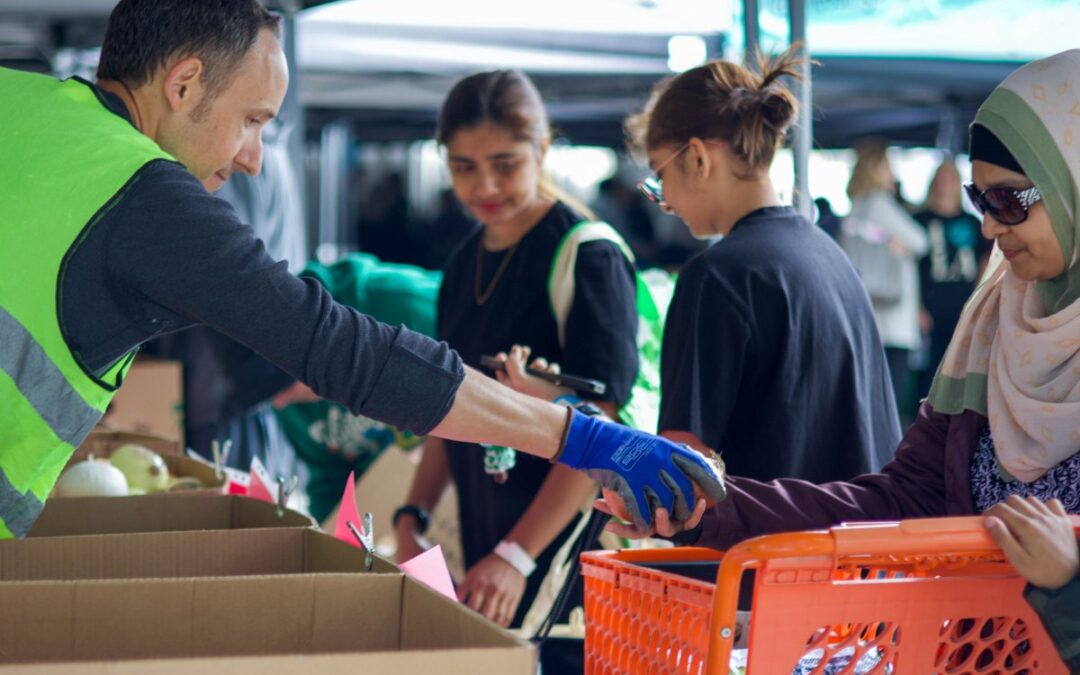
Rescue food. Feed people. Strengthen communities.
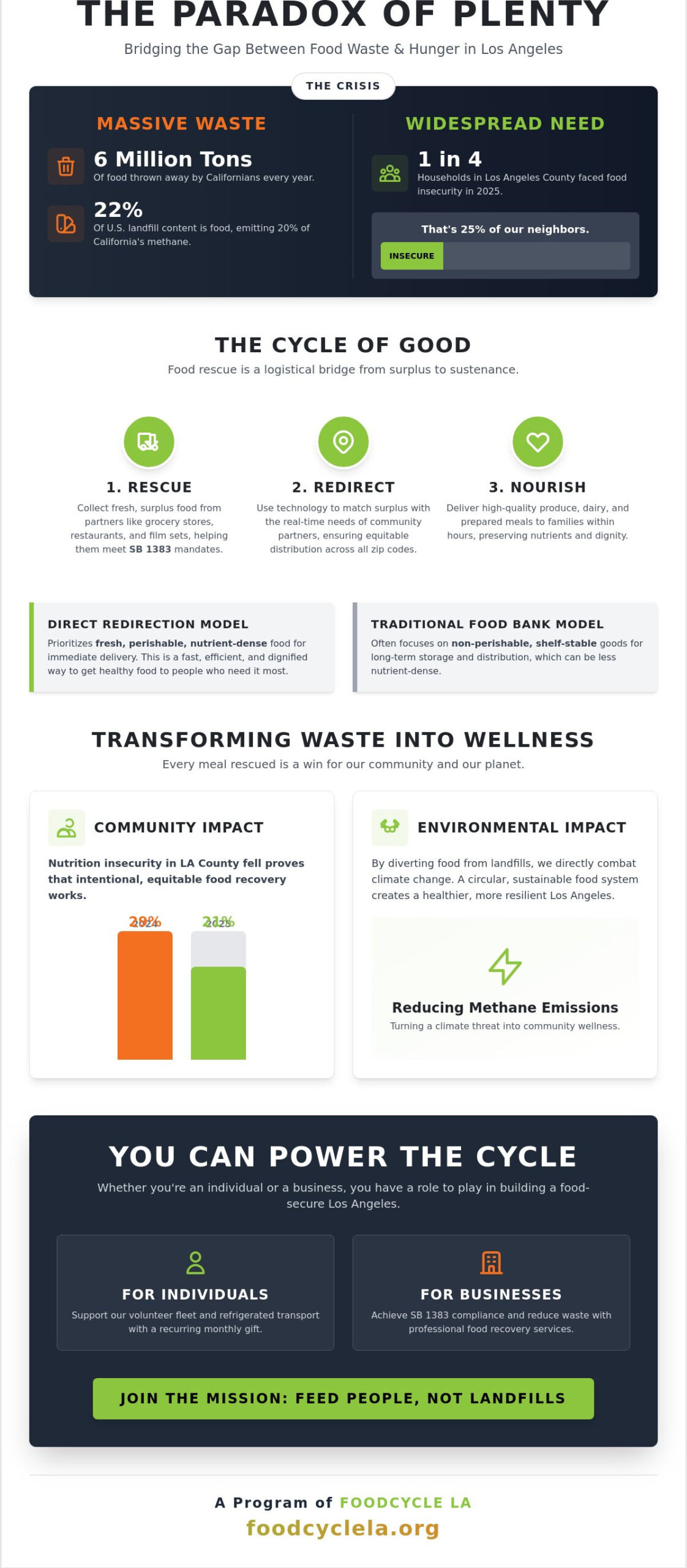
Every day in Los Angeles, perfectly good food is discarded while one in four households struggles to put healthy meals on the table. The problem isn’t a lack of food—it’s a disconnect between surplus and need.
At FoodCycle, we believe nutritious food belongs on plates, not in landfills. Since 2019, we’ve rescued more than 33 million pounds of surplus food, providing the equivalent of more than 27 million meals while reducing greenhouse gas emissions and strengthening the nonprofit organizations serving our communities.
Food recovery is more than an environmental solution—it’s an investment in healthier neighborhoods, stronger partnerships, and a more resilient food system.
In this article, we’ll explore why food recovery matters, how California’s food waste laws are transforming the way businesses manage surplus food, and how FoodCycle is helping create lasting systems change through collaboration.
Key Takeaways
- Hunger is a logistical failure, not a lack of resources. Learn how food rescue bridges the gap between massive surplus and the one in four LA households facing insecurity.
- Discover why the “direct redirection” model is a more efficient, nutrient-dense alternative to traditional food banking for fresh, perishable goods.
- Find out how you can help feed hungry los angeles residents by supporting the infrastructure that turns potential waste into immediate nourishment.
- Learn the practical steps for engagement, from individual monthly giving to how local businesses can achieve SB 1383 compliance through professional recovery services.
- Explore how we are building a sustainable “Cycle of Good” where every neighbor has a seat at the table and food feeds people, not landfills.
Table of Contents
The Human Cost of Inequity
Food insecurity continues to affect families in every corner of Los Angeles County. In 2025, nearly one in four households experienced food insecurity, including many working families who earn too much to qualify for public assistance but still struggle with the region’s high cost of living.
At the same time, millions of pounds of wholesome food are discarded every day.
This isn’t simply a food supply issue—it’s a distribution challenge.
FoodCycle works to bridge that gap by connecting surplus food from grocery stores, restaurants, manufacturers, farms, and other food businesses with local nonprofit organizations that serve seniors, families, veterans, students, and individuals experiencing homelessness.
Every rescued donation represents more than a meal. It supports community organizations, reduces pressure on household budgets, and helps ensure that nutritious food reaches the people who need it most.
Everyone deserves access to healthy food with dignity, regardless of where they live or how much they earn.
The Environmental Toll of Food Waste
Food waste affects more than hunger—it also has significant environmental consequences.
Organic waste is one of California’s largest sources of methane emissions, a greenhouse gas far more potent than carbon dioxide over the short term. Meanwhile, Californians discard an estimated 5 to 6 million tons of food each year, much of it still safe to eat.
Food recovery addresses both challenges simultaneously.
By rescuing edible food before it enters the waste stream, FoodCycle helps reduce landfill emissions while putting nutritious meals into local communities.
Every pound of food recovered conserves the resources already invested in producing it—including water, energy, farmland, and labor—and moves us closer to a circular food system where valuable resources are used to nourish people rather than generate waste.
Protecting our environment and feeding our communities are not competing priorities—they’re part of the same solution.
How Food Rescue Turns Surplus into Sustenance
Food recovery is built on one simple idea: good food should never go to waste.
Every day, grocery stores, restaurants, food manufacturers, farms, and wholesalers have surplus food that remains perfectly safe to eat but can no longer be sold. Without an efficient recovery system, much of this food would end up in landfills.
FoodCycle creates that connection.
Our logistics network rescues fresh produce, prepared meals, dairy products, baked goods, protein, and shelf-stable foods, then quickly redistributes them to nonprofit organizations across Los Angeles County.
Unlike traditional food storage models, food rescue emphasizes speed. Fresh food is often delivered within hours of collection, helping preserve both nutritional quality and food safety.
The result is healthier meals for community members while dramatically reducing unnecessary waste.
Food recovery isn’t simply about moving food—it’s about strengthening the systems that connect abundance with need.
The Logistics of Local Hope
Behind every successful food rescue is an extensive network of people, partnerships, and careful coordination.
FoodCycle works with more than 500 food donors and hundreds of nonprofit partners throughout Los Angeles County. Every day, our drivers and volunteers coordinate pickups and deliveries that move food efficiently from businesses to community organizations.
That logistics network has allowed FoodCycle to rescue more than 33 million pounds of food since 2019, including 11 million pounds in 2025 alone.
Our goal isn’t simply to collect food—it’s to ensure that the right food reaches the right organizations at the right time.
By building long-term relationships with both food donors and nonprofit partners, we’re helping create a stronger, more reliable food recovery infrastructure that benefits entire communities.
Powered by People and Technology
Technology makes large-scale food recovery possible, but people make it meaningful.
FoodCycle combines real-time logistics software with an extraordinary network of volunteers, drivers, nonprofit partners, and food donors. Smart routing allows available food to be matched quickly with organizations that can immediately distribute it, minimizing waste while maximizing community impact.
Behind every successful rescue is a team of individuals committed to solving problems together.
From volunteers who dedicate an hour to completing a food rescue route to businesses that donate surplus food every day, each partner plays an essential role in building a more sustainable food system.
Technology improves efficiency.
People create impact.
Together, they make food recovery possible.
Rescue vs. Traditional Food Banks: Maximizing Community Impact
Food rescue and traditional food banks share the same goal—ensuring people have access to nutritious food—but they serve complementary roles within the food system.
Traditional food banks provide an essential safety net by purchasing, storing, and distributing millions of pounds of food through regional warehouses. FoodCycle strengthens that system by rescuing fresh, surplus food before it becomes waste and delivering it directly to community organizations while it’s still at peak quality.
This decentralized model allows fresh fruits, vegetables, dairy, proteins, prepared meals, and baked goods to reach nonprofit partners quickly, often within hours of donation.
Together, food banks and food rescue organizations create a stronger, more resilient food network that provides both shelf-stable staples and fresh, nutritious food to communities throughout Los Angeles County.
Efficiency and Nutritional Dignity
Everyone deserves access to healthy, nutritious food.
Much of the food rescued by FoodCycle includes fresh produce, prepared meals, dairy products, proteins, and other nutrient-rich foods that can be difficult for smaller nonprofits to obtain consistently.
By moving food directly from donor to community partner, we reduce unnecessary storage costs, preserve freshness, and maximize the value of every donation.
This efficient approach allows neighborhood organizations—including food pantries, shelters, senior centers, youth programs, and community meal programs—to offer healthier food choices while using more of their resources to serve people.
Food recovery isn’t about distributing leftovers—it’s about ensuring high-quality food nourishes our communities instead of ending up in landfills.
The Environmental Dividend
Every food rescue benefits both people and the planet.
When edible food is diverted from landfills, we reduce methane emissions while conserving the water, energy, land, and labor required to produce that food in the first place.
Food recovery represents one of the most immediate and practical climate solutions available to communities today.
Since 2019, FoodCycle has rescued more than 33 million pounds of food, preventing millions of pounds of unnecessary greenhouse gas emissions while providing the equivalent of more than 27 million meals.
Every successful rescue demonstrates that environmental stewardship and community well-being go hand in hand.
Practical Ways to Help Feed Our Communities
Ending food waste requires all of us.
Whether you’re an individual, business owner, community organization, or volunteer, there are meaningful ways to strengthen Los Angeles’ food recovery network.
Every donation, volunteer shift, business partnership, and food rescue helps move nutritious food to neighbors who need it while creating a more sustainable food system for everyone.
When communities work together, surplus becomes opportunity.
For Individuals: Every Gift Creates Lasting Impact
Financial support keeps FoodCycle’s rescue network moving every day.
Your donation helps fuel refrigerated vehicles, support volunteer coordination, expand technology, and connect surplus food with nonprofit partners across Los Angeles County.
Monthly giving is especially valuable because it provides reliable funding that allows FoodCycle to plan for growth, respond to increasing demand, and rescue even more food throughout the year.
Whether your contribution is large or small, every dollar helps transform surplus food into healthy meals for our communities.
For Businesses: Turning Surplus into Community Impact
Businesses play a critical role in building a more sustainable food system.
California’s SB 1383 requires many grocery stores, wholesalers, restaurants, and other food businesses to recover the maximum amount of edible surplus food. FoodCycle helps businesses meet these requirements through reliable food recovery, detailed reporting, and seamless logistics.
But compliance is only part of the story.
Donating surplus food also reduces disposal costs, strengthens community relationships, supports corporate sustainability goals, and demonstrates a commitment to environmental stewardship.
FoodCycle works closely with businesses to make food donation simple, efficient, and measurable. Our team manages scheduling, transportation, documentation, and reporting, allowing businesses to focus on what they do best while knowing their surplus food is creating real community impact.
Many of our corporate partners also choose to deepen their involvement through volunteer service days, employee engagement opportunities, and sponsorships that expand food recovery throughout Los Angeles County.
Together, we’re proving that reducing food waste can strengthen businesses, communities, and the environment at the same time.
Volunteer. Advocate. Inspire.
FoodCycle’s work is powered by people who believe that good food should never go to waste.
Whether you’re completing a food rescue route, helping at a community distribution, supporting logistics at our Food Hub, or participating in a corporate volunteer event, your time directly helps feed neighbors and reduce waste.
Advocacy is equally important.
By sharing the importance of food recovery, encouraging businesses to donate surplus food, and supporting policies that reduce waste, you help build a stronger, more resilient food system for everyone.
Every volunteer, every conversation, and every food rescue helps move Los Angeles closer to a future where edible food is valued as a community resource—not discarded as waste.
Joining the FoodCycle Mission: Feeding People, Not Landfills
At FoodCycle, we believe no one should go hungry while good food goes to waste.
For more than 15 years, we’ve worked to build the partnerships, infrastructure, and technology needed to connect surplus food with the people who need it most. What began with a single volunteer rescuing food from one grocery store has grown into one of Los Angeles County’s leading food recovery organizations, working alongside businesses, nonprofit organizations, municipalities, and volunteers to strengthen the region’s food system.
Our mission extends beyond rescuing food. We’re helping transform the way communities think about surplus food—viewing it not as waste, but as a valuable resource that can nourish people, strengthen neighborhoods, and protect our environment.
Real change happens through collaboration. Every grocery store that donates food, every volunteer who completes a rescue route, every nonprofit partner that distributes healthy meals, and every business that invests in food recovery helps build a stronger, more connected community.
Together, we’re creating a future where surplus food feeds people—not landfills.
Our Impact in Los Angeles
FoodCycle measures success one food rescue, one partnership, and one meal at a time.
Since 2019, together with our donors, volunteers, and nonprofit partners, we have:
-
Rescued more than 33 million pounds of nutritious food
-
Provided the equivalent of more than 27 million meals
-
Rescued 11 million pounds of food in 2025 alone
-
Partnered with more than 500 food donors
-
Supported hundreds of nonprofit organizations serving communities throughout Los Angeles County
-
Prevented millions of pounds of greenhouse gas emissions by keeping edible food out of landfills
But these numbers tell only part of the story.
Behind every statistic is a senior receiving fresh produce, a family stretching their grocery budget, a child enjoying a healthy meal after school, or a community organization able to expand its services because fresh food is consistently available.
FoodCycle also works beyond direct food recovery by helping businesses comply with California’s SB 1383 edible food recovery requirements, supporting municipalities as they expand food recovery programs, and bringing together leaders across sectors to strengthen collaboration.
Whether convening regional conferences, developing new partnerships, or helping businesses build sustainable food donation programs, our goal is the same: create a food system where nutritious food reaches people instead of becoming waste.
This systems-based approach allows every rescued pound of food to create lasting community impact.
Take Your First Step
Everyone has something to contribute.
Whether you’re looking to make a charitable donation, volunteer a few hours each month, organize a corporate volunteer day, or donate surplus food from your business, your involvement helps strengthen Los Angeles’ food recovery network.
Individuals help keep our rescue fleet moving.
Businesses transform surplus food into community impact.
Volunteers make thousands of food rescues possible each year.
Community partners ensure rescued food reaches neighbors with dignity and care.
Every partnership helps build a stronger, healthier, and more sustainable Los Angeles.
Build the Cycle of Good Today
Food insecurity and food waste are two sides of the same challenge—but together, they’re solvable.
Every day, nutritious food is available. Every day, community organizations are ready to distribute it. The opportunity lies in creating the connections that bring them together.
That’s exactly what FoodCycle does.
By investing in food recovery, you’re supporting more than meals. You’re strengthening local nonprofits, reducing greenhouse gas emissions, helping businesses meet their sustainability goals, and building a more resilient food system that benefits everyone.
Since 2019, our community has rescued more than 33 million pounds of food, but we know there’s much more we can accomplish together.
Whether you choose to give, volunteer, sponsor a program, or become a food donor, you’ll be joining a growing movement that’s proving healthy food belongs on tables—not in landfills.
Join FoodCycle today.
Donate to help rescue more nutritious food.
Volunteer and become part of our food recovery network.
Partner with us to recover surplus food from your business.
Sponsor a corporate volunteer experience that strengthens your team while creating meaningful community impact.
Together, we can build a future where every edible meal reaches a neighbor, every community has access to healthy food, and no good food goes to waste.
Feed People. Not Landfills.
Frequently Asked Questions About Food Recovery
How does FoodCycle ensure rescued food is safe to eat?
Food safety is our highest priority. We work only with food that is wholesome and safe for human consumption, following strict food safety guidelines and California regulations. Our trained staff and volunteers use proper handling procedures, temperature controls, and rapid transportation to ensure fresh food reaches our nonprofit partners safely and quickly.
Is my donation to FoodCycle tax-deductible?
Yes. FoodCycle is a registered 501(c)(3) nonprofit organization, and financial donations are tax-deductible to the extent allowed by law. Every donation helps fund the transportation, technology, and logistics needed to rescue nutritious food and deliver it to community organizations throughout Los Angeles County.
How can my business donate surplus food?
It’s easy to become a FoodCycle food donor. We work with grocery stores, restaurants, wholesalers, manufacturers, farms, caterers, corporate campuses, and other food businesses to schedule regular or on-demand food pickups.
Our team handles the logistics, transportation, and reporting so your surplus food reaches local nonprofit organizations instead of ending up in a landfill.
How does FoodCycle help businesses comply with SB 1383?
FoodCycle helps businesses meet California’s SB 1383 edible food recovery requirements by providing reliable food rescue services, detailed donation tracking, and documentation that supports compliance.
Beyond meeting regulatory requirements, businesses also reduce food waste, strengthen community partnerships, and advance their sustainability goals through food donation.
Does the Good Samaritan Food Donation Act protect food donors?
Yes. The federal Bill Emerson Good Samaritan Food Donation Act, along with California law, provides liability protection for businesses and individuals who donate food in good faith to qualified nonprofit organizations.
These protections make it possible for businesses to donate wholesome surplus food with confidence while helping reduce hunger and food waste.
Can my company volunteer with FoodCycle?
Absolutely.
FoodCycle offers meaningful corporate volunteer opportunities that combine team building with measurable community impact. Volunteer groups can participate in food sorting, community distributions, food rescue projects, and other hands-on activities that help feed neighbors while reducing food waste.
Many businesses also choose to combine volunteer service with sponsorships or long-term partnerships that support FoodCycle’s mission throughout the year.
Can I volunteer if I only have a few hours?
Yes. Many FoodCycle volunteer opportunities are flexible and can be completed in as little as one to two hours.
Whether you’re interested in driving a food rescue route, helping at a community distribution, or supporting special events, every volunteer plays an important role in strengthening Los Angeles’ food recovery network.
What kinds of food can be donated?
FoodCycle rescues a wide variety of wholesome surplus food, including:
- Fresh fruits and vegetables
- Dairy products
- Meat, poultry, and seafood
- Prepared meals
- Baked goods
- Shelf-stable foods
Every donation is evaluated to ensure it meets food safety standards before being distributed to nonprofit partners.
Where does the rescued food go?
FoodCycle partners with hundreds of nonprofit organizations throughout Los Angeles County, including food pantries, shelters, senior centers, youth programs, schools, community meal programs, and organizations serving veterans and families.
Our goal is to move food quickly so it reaches people while it’s still fresh and nutritious.
What impact has FoodCycle made?
Since 2019, FoodCycle has:
- Rescued more than 33 million pounds of nutritious food
- Provided the equivalent of more than 27 million meals
- Partnered with more than 500 food donors
- Supported hundreds of nonprofit organizations
- Helped businesses and municipalities expand food recovery throughout Los Angeles County
Every rescued pound of food helps nourish our communities while reducing greenhouse gas emissions and keeping valuable resources out of landfills.
How can I support FoodCycle?
There are many ways to get involved:
- Donate to support daily food recovery operations.
- Volunteer on a food rescue route or at a community event.
- Become a food donor if your business has surplus food.
- Sponsor a corporate volunteer day or community program.
- Partner with FoodCycle to help build a stronger, more sustainable food system.
Together, we can ensure that good food reaches people—not landfills.
Ready to Make an Impact?
Every day, good food goes to waste while families across Los Angeles face food insecurity. Together, we can change that.
How can my business donate surplus food?
It’s easy to become a FoodCycle food donor. We work with grocery stores, restaurants, wholesalers, manufacturers, farms, caterers, corporate campuses, and other food businesses to schedule regular or on-demand food pickups.
Our team handles the logistics, transportation, and reporting so your surplus food reaches local nonprofit organizations instead of ending up in a landfill.
How does FoodCycle help businesses comply with SB 1383?
FoodCycle helps businesses meet California’s SB 1383 edible food recovery requirements by providing reliable food rescue services, detailed donation tracking, and documentation that supports compliance.
Beyond meeting regulatory requirements, businesses also reduce food waste, strengthen community partnerships, and advance their sustainability goals through food donation.
Does the Good Samaritan Food Donation Act protect food donors?
Yes. The federal Bill Emerson Good Samaritan Food Donation Act, along with California law, provides liability protection for businesses and individuals who donate food in good faith to qualified nonprofit organizations.
These protections make it possible for businesses to donate wholesome surplus food with confidence while helping reduce hunger and food waste.
Can my company volunteer with FoodCycle?
Absolutely.
FoodCycle offers meaningful corporate volunteer opportunities that combine team building with measurable community impact. Volunteer groups can participate in food sorting, community distributions, food rescue projects, and other hands-on activities that help feed neighbors while reducing food waste.
Many businesses also choose to combine volunteer service with sponsorships or long-term partnerships that support FoodCycle’s mission throughout the year.
Can I volunteer if I only have a few hours?
Yes. Many FoodCycle volunteer opportunities are flexible and can be completed in as little as one to two hours.
Whether you’re interested in driving a food rescue route, helping at a community distribution, or supporting special events, every volunteer plays an important role in strengthening Los Angeles’ food recovery network.
What kinds of food can be donated?
FoodCycle rescues a wide variety of wholesome surplus food, including:
- Fresh fruits and vegetables
- Dairy products
- Meat, poultry, and seafood
- Prepared meals
- Baked goods
- Shelf-stable foods
Every donation is evaluated to ensure it meets food safety standards before being distributed to nonprofit partners.
Where does the rescued food go?
FoodCycle partners with hundreds of nonprofit organizations throughout Los Angeles County, including food pantries, shelters, senior centers, youth programs, schools, community meal programs, and organizations serving veterans and families.
Our goal is to move food quickly so it reaches people while it’s still fresh and nutritious.
What impact has FoodCycle made?
Since 2019, FoodCycle has:
- Rescued more than 33 million pounds of nutritious food
- Provided the equivalent of more than 27 million meals
- Partnered with more than 500 food donors
- Supported hundreds of nonprofit organizations
- Helped businesses and municipalities expand food recovery throughout Los Angeles County
Every rescued pound of food helps nourish our communities while reducing greenhouse gas emissions and keeping valuable resources out of landfills.
How can I support FoodCycle?
There are many ways to get involved:
- Donate to support daily food recovery operations.
- Volunteer on a food rescue route or at a community event.
- Become a food donor if your business has surplus food.
- Sponsor a corporate volunteer day or community program.
- Partner with FoodCycle to help build a stronger, more sustainable food system.
Together, we can ensure that good food reaches people—not landfills.
Ready to Make an Impact?
Every day, good food goes to waste while families across Los Angeles face food insecurity. Together, we can change that.
Our team handles the logistics, transportation, and reporting so your surplus food reaches local nonprofit organizations instead of ending up in a landfill.
Beyond meeting regulatory requirements, businesses also reduce food waste, strengthen community partnerships, and advance their sustainability goals through food donation.
Does the Good Samaritan Food Donation Act protect food donors?
Yes. The federal Bill Emerson Good Samaritan Food Donation Act, along with California law, provides liability protection for businesses and individuals who donate food in good faith to qualified nonprofit organizations.
These protections make it possible for businesses to donate wholesome surplus food with confidence while helping reduce hunger and food waste.
Can my company volunteer with FoodCycle?
Absolutely.
FoodCycle offers meaningful corporate volunteer opportunities that combine team building with measurable community impact. Volunteer groups can participate in food sorting, community distributions, food rescue projects, and other hands-on activities that help feed neighbors while reducing food waste.
Many businesses also choose to combine volunteer service with sponsorships or long-term partnerships that support FoodCycle’s mission throughout the year.
Can I volunteer if I only have a few hours?
Yes. Many FoodCycle volunteer opportunities are flexible and can be completed in as little as one to two hours.
Whether you’re interested in driving a food rescue route, helping at a community distribution, or supporting special events, every volunteer plays an important role in strengthening Los Angeles’ food recovery network.
What kinds of food can be donated?
FoodCycle rescues a wide variety of wholesome surplus food, including:
- Fresh fruits and vegetables
- Dairy products
- Meat, poultry, and seafood
- Prepared meals
- Baked goods
- Shelf-stable foods
Every donation is evaluated to ensure it meets food safety standards before being distributed to nonprofit partners.
Where does the rescued food go?
FoodCycle partners with hundreds of nonprofit organizations throughout Los Angeles County, including food pantries, shelters, senior centers, youth programs, schools, community meal programs, and organizations serving veterans and families.
Our goal is to move food quickly so it reaches people while it’s still fresh and nutritious.
What impact has FoodCycle made?
Since 2019, FoodCycle has:
- Rescued more than 33 million pounds of nutritious food
- Provided the equivalent of more than 27 million meals
- Partnered with more than 500 food donors
- Supported hundreds of nonprofit organizations
- Helped businesses and municipalities expand food recovery throughout Los Angeles County
Every rescued pound of food helps nourish our communities while reducing greenhouse gas emissions and keeping valuable resources out of landfills.
How can I support FoodCycle?
There are many ways to get involved:
- Donate to support daily food recovery operations.
- Volunteer on a food rescue route or at a community event.
- Become a food donor if your business has surplus food.
- Sponsor a corporate volunteer day or community program.
- Partner with FoodCycle to help build a stronger, more sustainable food system.
Together, we can ensure that good food reaches people—not landfills.
Ready to Make an Impact?
Every day, good food goes to waste while families across Los Angeles face food insecurity. Together, we can change that.
These protections make it possible for businesses to donate wholesome surplus food with confidence while helping reduce hunger and food waste.
FoodCycle offers meaningful corporate volunteer opportunities that combine team building with measurable community impact. Volunteer groups can participate in food sorting, community distributions, food rescue projects, and other hands-on activities that help feed neighbors while reducing food waste.
Many businesses also choose to combine volunteer service with sponsorships or long-term partnerships that support FoodCycle’s mission throughout the year.
Can I volunteer if I only have a few hours?
Yes. Many FoodCycle volunteer opportunities are flexible and can be completed in as little as one to two hours.
Whether you’re interested in driving a food rescue route, helping at a community distribution, or supporting special events, every volunteer plays an important role in strengthening Los Angeles’ food recovery network.
What kinds of food can be donated?
FoodCycle rescues a wide variety of wholesome surplus food, including:
- Fresh fruits and vegetables
- Dairy products
- Meat, poultry, and seafood
- Prepared meals
- Baked goods
- Shelf-stable foods
Every donation is evaluated to ensure it meets food safety standards before being distributed to nonprofit partners.
Where does the rescued food go?
FoodCycle partners with hundreds of nonprofit organizations throughout Los Angeles County, including food pantries, shelters, senior centers, youth programs, schools, community meal programs, and organizations serving veterans and families.
Our goal is to move food quickly so it reaches people while it’s still fresh and nutritious.
What impact has FoodCycle made?
Since 2019, FoodCycle has:
- Rescued more than 33 million pounds of nutritious food
- Provided the equivalent of more than 27 million meals
- Partnered with more than 500 food donors
- Supported hundreds of nonprofit organizations
- Helped businesses and municipalities expand food recovery throughout Los Angeles County
Every rescued pound of food helps nourish our communities while reducing greenhouse gas emissions and keeping valuable resources out of landfills.
How can I support FoodCycle?
There are many ways to get involved:
- Donate to support daily food recovery operations.
- Volunteer on a food rescue route or at a community event.
- Become a food donor if your business has surplus food.
- Sponsor a corporate volunteer day or community program.
- Partner with FoodCycle to help build a stronger, more sustainable food system.
Together, we can ensure that good food reaches people—not landfills.
Ready to Make an Impact?
Every day, good food goes to waste while families across Los Angeles face food insecurity. Together, we can change that.
Whether you’re interested in driving a food rescue route, helping at a community distribution, or supporting special events, every volunteer plays an important role in strengthening Los Angeles’ food recovery network.
- Fresh fruits and vegetables
- Dairy products
- Meat, poultry, and seafood
- Prepared meals
- Baked goods
- Shelf-stable foods
Every donation is evaluated to ensure it meets food safety standards before being distributed to nonprofit partners.
Where does the rescued food go?
FoodCycle partners with hundreds of nonprofit organizations throughout Los Angeles County, including food pantries, shelters, senior centers, youth programs, schools, community meal programs, and organizations serving veterans and families.
Our goal is to move food quickly so it reaches people while it’s still fresh and nutritious.
What impact has FoodCycle made?
Since 2019, FoodCycle has:
- Rescued more than 33 million pounds of nutritious food
- Provided the equivalent of more than 27 million meals
- Partnered with more than 500 food donors
- Supported hundreds of nonprofit organizations
- Helped businesses and municipalities expand food recovery throughout Los Angeles County
Every rescued pound of food helps nourish our communities while reducing greenhouse gas emissions and keeping valuable resources out of landfills.
How can I support FoodCycle?
There are many ways to get involved:
- Donate to support daily food recovery operations.
- Volunteer on a food rescue route or at a community event.
- Become a food donor if your business has surplus food.
- Sponsor a corporate volunteer day or community program.
- Partner with FoodCycle to help build a stronger, more sustainable food system.
Together, we can ensure that good food reaches people—not landfills.
Ready to Make an Impact?
Every day, good food goes to waste while families across Los Angeles face food insecurity. Together, we can change that.
Our goal is to move food quickly so it reaches people while it’s still fresh and nutritious.
- Rescued more than 33 million pounds of nutritious food
- Provided the equivalent of more than 27 million meals
- Partnered with more than 500 food donors
- Supported hundreds of nonprofit organizations
- Helped businesses and municipalities expand food recovery throughout Los Angeles County
Every rescued pound of food helps nourish our communities while reducing greenhouse gas emissions and keeping valuable resources out of landfills.
How can I support FoodCycle?
There are many ways to get involved:
- Donate to support daily food recovery operations.
- Volunteer on a food rescue route or at a community event.
- Become a food donor if your business has surplus food.
- Sponsor a corporate volunteer day or community program.
- Partner with FoodCycle to help build a stronger, more sustainable food system.
Together, we can ensure that good food reaches people—not landfills.
Ready to Make an Impact?
Every day, good food goes to waste while families across Los Angeles face food insecurity. Together, we can change that.
- Donate to support daily food recovery operations.
- Volunteer on a food rescue route or at a community event.
- Become a food donor if your business has surplus food.
- Sponsor a corporate volunteer day or community program.
- Partner with FoodCycle to help build a stronger, more sustainable food system.
Together, we can ensure that good food reaches people—not landfills.
Join FoodCycle’s mission to Feed People. Not Landfills.
Ways to Get Involved
🍎 Donate – Help rescue more nutritious food and expand our impact.
🚚 Become a Food Donor – Turn your surplus food into healthy meals for your community.
🤝 Volunteer – Join a food rescue route or community distribution.
🏢 Partner with FoodCycle – Engage your employees through corporate volunteer experiences or sponsorships.
Together, we’re building a more sustainable, equitable, and connected food system—one food rescue at a time.