
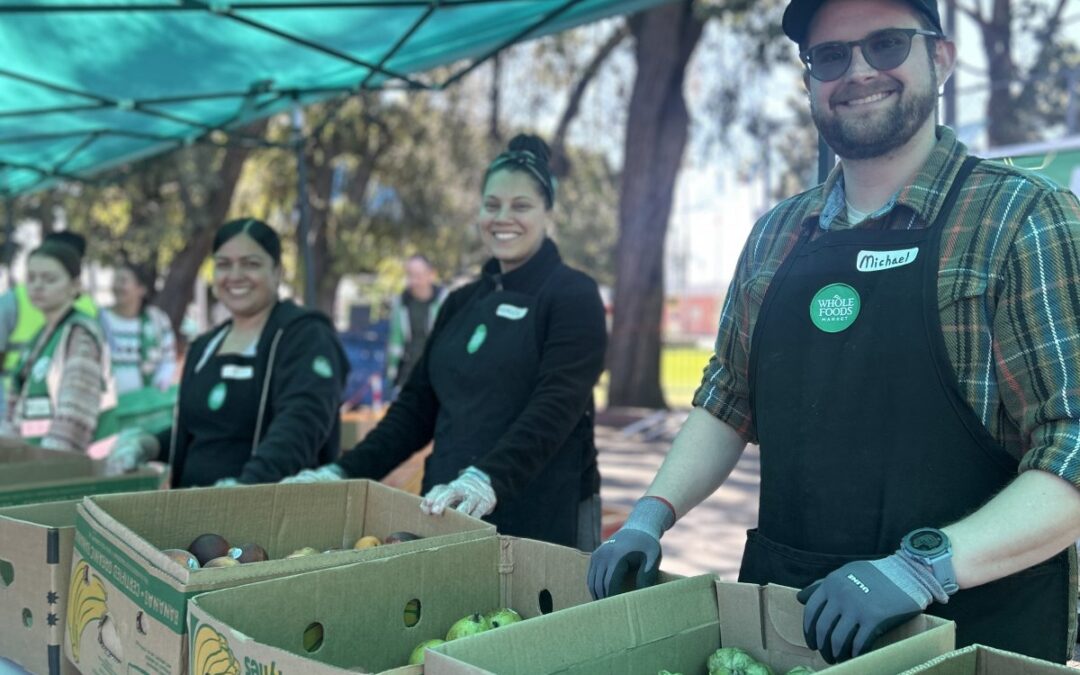
The best team-building experiences don’t just bring people together—they create lasting impact.
Across the country, more companies are looking for meaningful ways to engage employees, give back to their communities, and demonstrate their commitment to sustainability. At FoodCycle, we make it easy to turn a volunteer day into an experience your team will remember long after the last box of food is packed.
When your employees volunteer with FoodCycle, they’re doing more than lending a hand. They’re rescuing nutritious food that would otherwise go to waste, helping provide meals for families experiencing food insecurity, and supporting a more sustainable Los Angeles.
We know planning a corporate volunteer event can feel overwhelming. Coordinating schedules, accommodating large groups, and finding an opportunity that delivers real impact takes time. That’s where we come in. Our team handles the logistics so your employees can focus on working together, making connections, and seeing the difference they’re making firsthand.
Whether your team is sorting food, gleaning at a farmers market, preparing distributions, or supporting one of our food rescue operations, every volunteer shift helps strengthen the local food system while reducing greenhouse gas emissions from wasted food.
After your event, we’ll share the impact your team helped create—from pounds of food rescued and meals provided to the environmental benefits of keeping good food out of landfills—giving you meaningful data to celebrate your company’s commitment to your community and the planet.
Together, we can build stronger teams, stronger communities, and a future where good food feeds people—not landfills.
Key Takeaways
- Learn how to move beyond “busy work” by shifting your team-building toward systemic food recovery and high-impact community engagement.
- Discover how to coordinate a seamless corporate day of service la for teams of 10 to 40
- Gain the tools to measure your success with hard data, including metric tons of CO2e diverted and the number of meals rescued for neighbors in need.
- Find out why food rescue logistics offer a more immediate ROI for both your CSR goals and the environmental health of Los Angeles.
Table of Contents
What is a Corporate Day of Service and Why Does It Matter?
A corporate day of service la is more than a break from the office; it is a strategic investment in the city we call home. In 2026, the old model of "charity" is dead. We’ve moved toward impact-driven engagement where businesses don’t just "give back," they integrate social responsibility into their daily operations. Corporate volunteering has evolved from a nice-to-have perk into a vital component of urban infrastructure. It’s a dedicated time for your team to step away from their screens and engage directly with the social and environmental issues that define our local landscape.
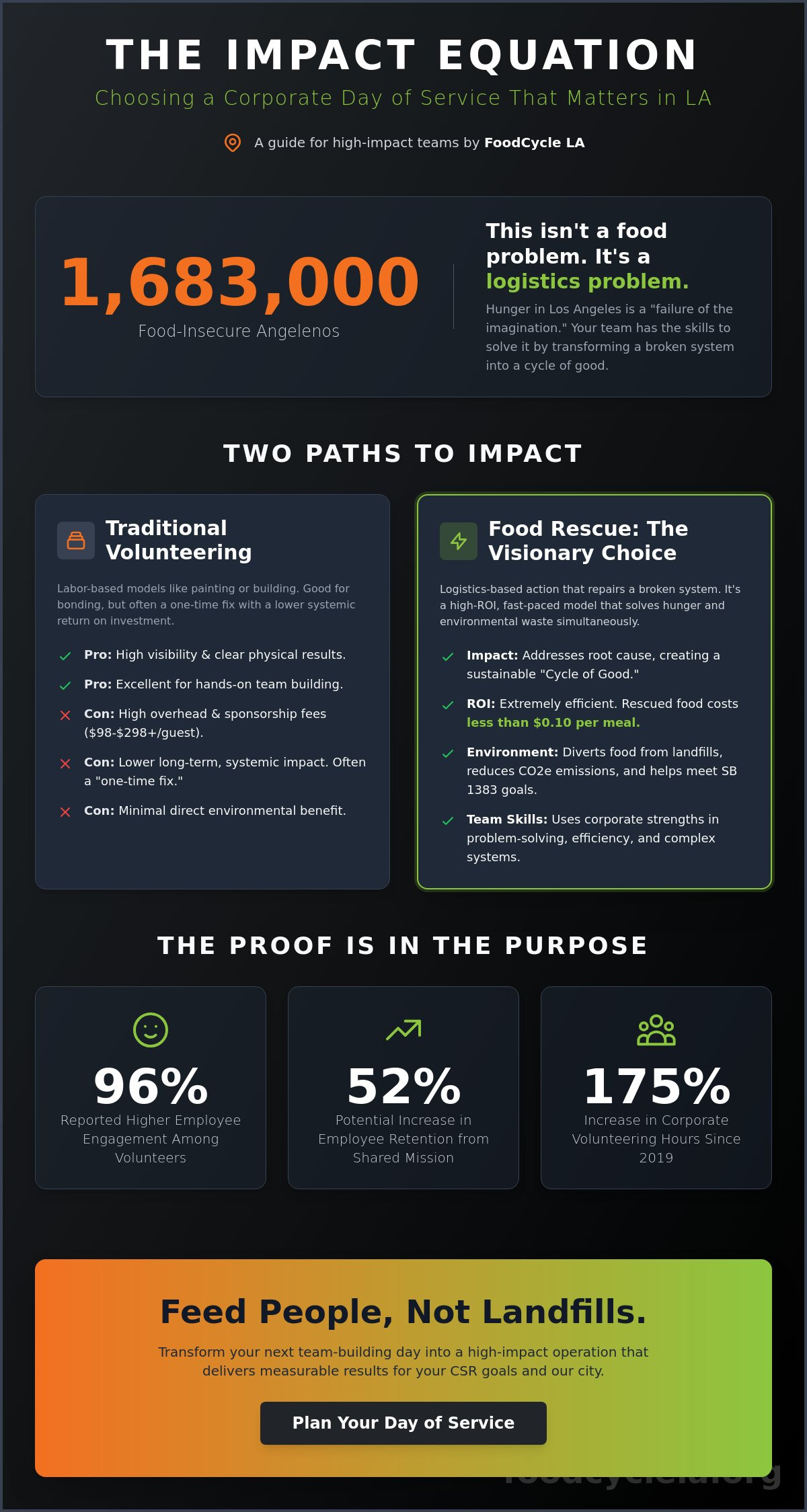
Los Angeles is a global hub of innovation, yet we face a staggering reality. There are 1,683,000 food-insecure Angelenos living in our neighborhoods. This isn’t a lack of food; it’s a failure of the imagination. We believe that "nourishing neighbors" should be a core business value, not an afterthought. When a company chooses to participate in a day of service, they’re ensuring that everyone has a seat at the table. It’s about moving from passive observation to active rescue.
The Benefits of Community Engagement for LA Teams
Impact matters to your bottom line. Data from May 2026 shows that 96% of companies report higher employee engagement among volunteers. When your team rescues surplus food, they aren’t just working; they’re bonding over a shared mission. Beyond the office walls, a corporate day of service la strengthens your local brand presence. It shows the community that you are a "Visionary Doer" committed to the local ecosystem. Your employees also develop leadership skills in high-stakes, real-world environments that no corporate retreat can replicate.
Addressing the ‘Failure of Imagination’ in Hunger Relief
Hunger is not a resource problem. It is a logistics problem. Every day, tons of perfectly good food head to landfills while our neighbors go hungry. We challenge the idea that this is an unsolvable crisis. Your team brings unique problem-solving skills, efficiency, and scale to this challenge. Corporate teams are built to handle complex systems, making them the perfect partners for food rescue. By redirecting surplus food, we create a "Cycle of Good" that nourishes the city and protects the environment. Food rescue is the most efficient form of service because it solves two problems at once: waste and want. We don’t just give food; we transform the system. Together, we can feed people, not landfills.
Traditional Volunteering: Pros and Cons
Labor-intensive projects are excellent for physical team building. They provide a clear beginning, middle, and end to a task. However, the long-term systemic impact is often lower. These models may require specialized skills your team doesn’t possess, and the high sponsorship fees often cover event amenities rather than the cause itself. It’s vital to analyze where your investment goes. Does it fund a party, or does it fund progress?
Planning Your LA Service Day: Logistics and Neighborhood Strateg
The food you serve your team should reflect the values of the work they are doing. Partnering with local restaurants that participate in surplus food programs or follow SB 1383 recovery standards creates a circular economy within your event. This means ensuring zero-waste practices are in place, from compostable packaging to the redirection of any leftover catering to local mutual aid sites. If your organization also generates surplus food regularly, learning how to set up food donation pickup for your Los Angeles business can extend your impact well beyond a single service day. When we source team meals from local partners committed to zero-waste, every bite becomes a reward for the team and a conscious investment in our community’s nourishment. This intentionality ensures that your service day is consistent from the first morning coffee to the final impact report.
Measuring Your Impact: From CO2e to Meals Rescued
Data is the language of leadership. A corporate day of service la should not just feel good; it must produce quantifiable results that satisfy stakeholders and prove the efficacy of your CSR initiatives. We move beyond simple headcounts and hours logged to measure the actual shift in the Los Angeles ecosystem. By translating every rescued crate of produce into tangible social and environmental metrics, we provide your team with the evidence needed for official ESG reporting. Your impact is real, and it is measurable.
Since the beginning of the pandemic, our collective efforts have provided over 33 million meals to those in need. When your team participates in food recovery, they aren’t just moving boxes. They’re strengthening a logistics network that rescued more than 11 million pounds of edible food in 2025 alone. This high-efficiency model ensures that your contribution directly supports the wellness of our neighbors while meeting the rigorous standards of modern impact reporting.
The Environmental Metric: Feeding People, Not Landfills
Food waste is a climate crisis hidden in plain sight. In Los Angeles, organic waste rotting in landfills is a primary driver of methane emissions, a greenhouse gas significantly more potent than CO2. Food rescue acts as a vital climate intervention by redirecting these resources before they become pollutants. Rescuing just one ton of surplus food prevents approximately 1.9 metric tons of CO2e emissions from entering our atmosphere, effectively serving as a direct carbon offset for your organization’s environmental footprint. By choosing this path, you help the city comply with SB 1383 and ensure we are building a sustainable, circular food system. Businesses looking to go further can also explore setting up ongoing food donation pickup for their Los Angeles operations to maintain this environmental benefit year-round.
The Social Metric: Wellness and Dignity
Numbers tell part of the story, but nourishment defines the rest. We look past "pounds of food" to focus on the quality of the nourishment provided to the 1,683,000 food-insecure Angelenos in our community. Every service day connects your team to the wellness and dignity of local families, ensuring that fresh, healthy food reaches the table rather than the trash. These impact stories humanize your data, allowing stakeholders to see the faces behind the metrics. When we strengthen the community, we strengthen the foundation upon which every business stands.
Ready to see your impact in action? Explore our corporate volunteer opportunities and start building your custom impact report today.
Partnering with FoodCycle for Your Day of Service
Rescue food. Redirect resources. Restore community. Partnering with FoodCycle LA for your corporate day of service la means joining a movement that views hunger as a solvable logistical challenge. We are not just a charity; we are a visionary engine of systemic change. Our corporate partnerships are designed for businesses that demand high-impact results and seamless execution. By choosing to work with us, you aren’t just sponsoring an event. You are fueling the infrastructure of food justice in Los Angeles and ensuring that our neighbors have the nourishment they deserve.
Our model is powered by people. We believe that the solution to hunger already exists within our city’s surplus, waiting to be unlocked through collective action and logistical precision. This is why our programs are entirely turnkey. We handle the complex coordination of surplus food recovery, site logistics, and nonprofit partnerships. This allows your team to step directly into the "Cycle of Good" without the burden of planning. Your sponsorship does more than fund a single day; it strengthens the very network that has rescued over 11 million pounds of food in a single year.
What to Expect During a FoodCycle Service Day
Preparation meets purpose. Your day begins with an educational briefing on the "failure of imagination" that allows food waste to persist alongside hunger. We move beyond the "charity" narrative to explain our systemic solutions for equitable food recovery. From there, your team engages directly with food rescue operations and local nonprofits in a high-energy, collaborative environment. It’s a fast-paced experience that builds genuine team bonds through shared responsibility. You won’t just be moving crates; you’ll be witnessing the immediate transformation of surplus food into community wellness.
Ready to Start the Cycle of Good?
Impact is calling. We are currently booking customized corporate sponsorship packages for the 2026 season. Whether you want to align your service day with major events like the 9/11 Day of Service in September, or the holidays, we can tailor an itinerary that meets your specific CSR goals and group size. Our team works with you to ensure every detail is handled with professional care. Together, we can build a Los Angeles where no edible food goes to waste and no neighbor goes hungry.
Join us in nourishing Los Angeles-Schedule your Day of Service
Build a Circular Future for Los Angeles
Your next team-building event can be a catalyst for systemic change. We’ve explored how choosing logistics over simple labor creates a higher ROI for our community and the environment. By focusing on hyper-local neighborhood strategies and leveraging turnkey solutions, your corporate day of service la becomes an efficient engine of nourishment. You now have the tools to measure success through metric tons of CO2e diverted and the thousands of meals we rescue daily..
Frequently Asked Questions
How do I organize a corporate volunteer event in LA?
Organizing a successful event begins with selecting a mission that aligns with your company values and choosing a turnkey partner to manage the logistics. We recommend focusing on food recovery because it provides a high ROI for the community and simplifies the coordination of large groups.
What are the best corporate volunteer opportunities in Los Angeles for large groups?
Food rescue logistics offer the most scalable and high-energy environment for large teams. This model allows your entire staff to work in parallel, rescuing surplus food and strengthening the city’s nourishment infrastructure.
Are corporate service days tax-deductible for my business?
Yes, sponsorships and donations made to a registered 501(c)(3) nonprofit like FoodCycle LA are typically tax-deductible. We provide the necessary documentation and impact data to support your financial records. It’s best to consult with your tax professional to determine how these contributions benefit your specific business under current IRS guidelines.
How can we measure the impact of our company’s volunteer day?
Impact is measured through tangible social and environmental metrics provided after your event. We track the specific number of meals rescued and the metric tons of CO2e diverted from landfills. These data points allow you to report concrete results to stakeholders, moving beyond simple headcounts to show real systemic change in Los Angeles.
Does FoodCycle provide logistics and transportation support?
We provide comprehensive infrastructure support for the rescue operations themselves. Our turnkey partnerships handle the coordination of surplus food sources and the delivery to local nonprofit partners. While teams generally manage their own transportation to the service site, we ensure all equipment and project management are ready for an efficient, high-impact intervention.
Can we combine a service day with a team lunch or offsite meeting?
Integrating a service day into a larger offsite meeting is an excellent way to foster team wellness. We encourage teams to partner with local restaurants that follow zero-waste practices for their catering needs. This creates a circular economy where your team meal supports the same mission of nourishment and environmental care that you practice during your service hours.
What is the difference between a day of service and a team-building event?
A corporate day of service la focuses on shared purpose and community impact rather than just social interaction. While traditional team-building might involve games, a service day unites employees through the act of solving a "failure of the imagination." It builds deeper bonds by allowing your team to rescue food and nourish neighbors together.
Is there a minimum group size for a corporate day of service?
We offer flexible opportunities that can be customized for groups of various sizes. We can also develop smaller, high-stakes interventions for executive teams who want to engage directly with the logistics of food justice in Los Angeles.